
Books Collection
This series of works explores the hidden financial and political history of the United States, from the early republic through the creation of the Federal Reserve. Each investigation traces how currency, credit, and legislative power have intertwined to shape the modern nation.

The Art of Political Finance
Part I – The Colonial Era Through Reconstruction
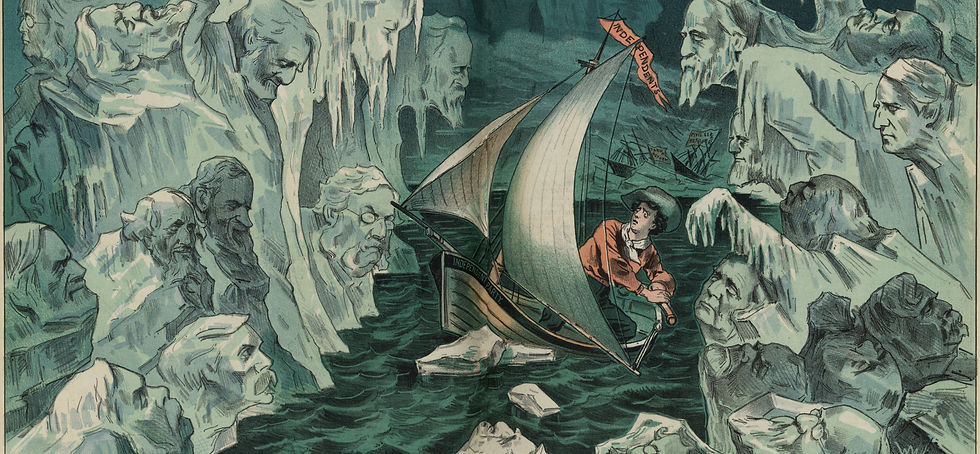
The Art of Political Finance – Part I – The Colonial Era Through Reconstruction is a macro-economic primer and orientation to the political and financial history of the United States. There are over 60 illustrations by artists and publishers like Frank Leslie and his Illustrated Newspaper, Thomas Nast and Harper's Weekly, Currier & Ives, Joseph Keppler and Puck Magazine, and others to guide you through this often uninspected history. It reveals trends through the history of money, banking, and party politics that were at the foundation of consolidated capital and the concentration of power. Part I confronts economic philosophy touching on the differences, similarities, and conflicts between Thomas Jefferson and Alexander Hamilton, Andrew Jackson, and Nicholas Biddle, and to the lesser-known ideas of Peter Cooper that often opposed financial officiating by John Sherman and his colleagues.

The Art of Political Finance
Part II – The Gilded Age
The Art of Political Finance Part II – The Gilded Age is a further look into the history of the United States picking up with Resumption in 1879 – the resumption of specie-based currency which put an end to the Greenback Era. As banking and party politics were yet at the foundation of consolidated capital, industrial dominance augmented the concentration of power. While Capitalism and wealth were lauded and used to apologize for transgressions against humanity, the people of the United States ceded not only to potentials of wealth but to the peace that goes along with prosperity. Guided by more than 90 illustrations from the period which were much more prolific and colorful, the text continues to analyze root cause and expose patterns in the commercial and banking arenas known as panics and depressions. These events, which are euphemized as business cycles, greatly affect the human experience and still require a resilient population to absorb. As the velocity of money encompassed the country, it also engulfed the political parties; the evolution of which is covered tangentially, showing the formation of a more homogenous central authority that obfuscated societal issues and usurped both the democratic participation and republican establishment.
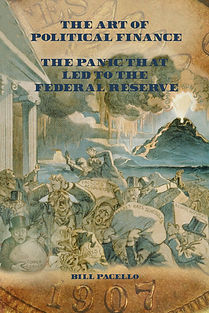
The Panic That Led to the Federal Reserve
The panic of 1907 once again revealed the fragility of New York City's economy. This prompted the money managers to devise a scheme that would perpetuate the misfeasance. That scheme was the Federal Reserve system which has normalized deficit spending at all levels of government. Since the Fed's establishment, the fiscal irresponsibility has become nationwide and in many urban areas.
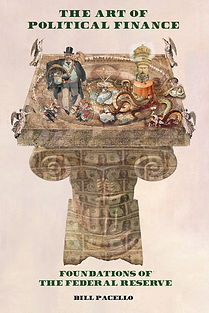
Foundations of the Federal Reserve
As calls for ending the Fed are being made, we should understand what the Federal Reserve is prior to conceiving its replacement. Foundations of The Federal Reserve provides the who, what, why, and how to the establishment of the Reserve. As the country and the world continue to divide along extreme party and philosophical lines, an understanding of the money system and this institution is imperative to an orientation to the past and present worldly strife.